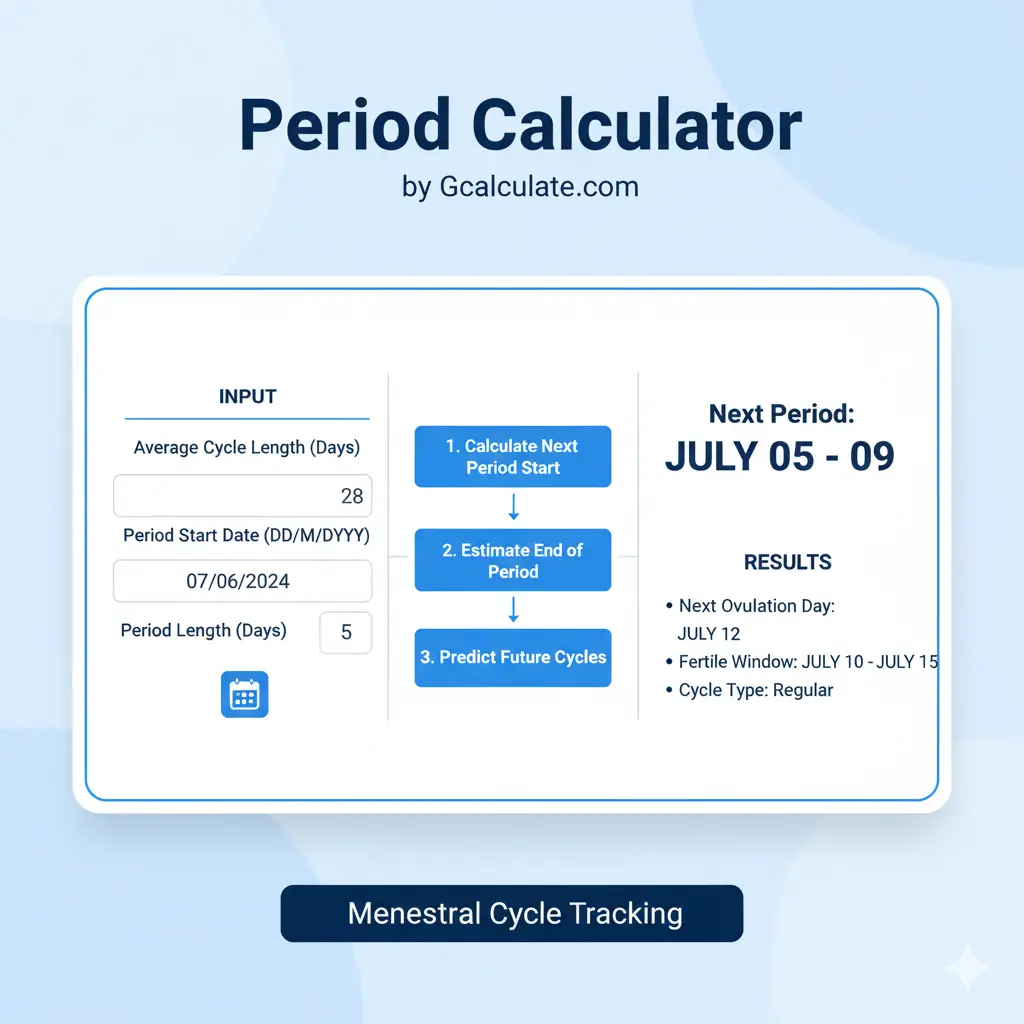
Period Calculator – Track Your Menstrual Cycle & Predict Your Next Period
Understanding your menstrual cycle is key to maintaining your reproductive health and planning your daily life with confidence. The Period Calculator on GCalculate.com helps you accurately predict your next period, track fertile days, and understand cycle patterns — all in one simple tool.
A Period Calculator, also known as an Ovulation Calculator & Calendar, is a free, user-friendly tool that predicts your menstrual cycle, ovulation dates, and fertile windows, empowering women to plan for menstruation, fertility, or health monitoring. In 2025, with ovulation predictor kits costing $20–$100 globally, this online tool offers a cost-free alternative to track your cycle accurately. By inputting your last menstrual period (LMP) and cycle length, it calculates upcoming period dates, ovulation, and fertility windows, making it ideal for women trying to conceive, managing symptoms, or maintaining health. Unlike manual tracking, which is error-prone, this Menstrual Cycle Calculator delivers instant, reliable results. Also check Pregnancy Due Date Calculator.
What is a Period Calculator?
A Period Calculator forecasts menstrual cycle events using your LMP and average cycle length (typically 21–35 days, averaging 28 days, per Mayo Clinic). It predicts:
Next Period Date: ~28 days from LMP.
Ovulation Date: ~Day 14 of a 28-day cycle.
Fertile Window: ~Days 10–15, when conception is most likely.
Safe Days: Days with low conception probability.
The formula for ovulation is: Ovulation Date = LMP + (Cycle Length – 14 days)
For example, an LMP of July 1, 2025, with a 28-day cycle predicts ovulation around July 15, 2025, and the next period on July 29, 2025. The calculator also generates an Ovulation Calendar to visualize your cycle, per American College of Obstetricians and Gynecologists (ACOG). Also check Body Max Index BMI Calculator for health status.
How to Calculate Next Period Date
Calculating your next period manually is simpler than you think! Start by noting the first day of your last menstrual period (LMP). Next, track your cycle length—the days from LMP to your next period. For example, if your LMP was May 1 and your cycle averages 28 days, your next period should arrive around May 29. For irregular cycles, use your shortest and longest cycles to estimate a range (e.g., 26–32 days). Formula: Next Period = LMP + Cycle Length. Add ±3 days for natural fluctuations. Keep a calendar or app to log dates, and after 3 months, you’ll spot patterns. Remember, stress, travel, or health changes can shift dates—so treat this as a guide, not a guarantee.
Period Calculator Pregnancy
Planning a pregnancy? A period calculator becomes your fertility ally. By predicting ovulation (typically 14 days before your next period), it pinpoints your fertile window—the 5 days when conception is most likely. For example, if your next period is due June 30, ovulation occurs around June 16, making June 11–16 your peak fertile days. It also estimates your due date if conception occurs: Due Date = LMP + 280 days. Beyond conception, it tracks early pregnancy signs (like missed periods or spotting) and schedules key milestones (e.g., “Take a pregnancy test if your period is 5+ days late”). While it’s a helpful tool, always confirm pregnancy with a test and consult a healthcare provider for personalized care.
Period Calculator Am I Late?
“Am I late?” is a question many of us ask. A period calculator answers it by comparing your expected period date to today’s date. Input your LMP and average cycle length—if the current date is 5+ days past your prediction, it flags “late.” For example, if your period was due June 1 and it’s now June 7, the calculator alerts you. Common causes of delays include stress, illness, hormonal changes, or pregnancy. If you’re sexually active, a late period is a key pregnancy sign—take a test. If the test is negative and your period still hasn’t arrived after 14 days, consult a doctor. This tool turns anxiety into action, helping you decide when to test or seek help.
Period Cycle Length Calculator
Understanding your cycle length is key to menstrual health. A period cycle length calculator analyzes your last 3–6 periods to reveal patterns. Input the start dates of your periods, and it computes:
Average cycle length (e.g., 28 days).
Period duration (bleeding length, usually 3–7 days).
Variability (e.g., cycles ranging 26–30 days).
For instance, periods starting Jan 1, Jan 29, and Feb 26 show a consistent 28-day cycle. If cycles vary wildly (e.g., 25, 35, 28 days), it flags irregularities. Why does this matter? Short cycles (<21 days) or long ones (>35 days) may signal conditions like PCOS or thyroid issues. By tracking trends, you gain insights into your reproductive health and know when to consult a professional.
Ovulation Period Calculator
An ovulation period calculator demystifies your fertile window. Using your cycle length, it estimates ovulation as 14 days before your next period and highlights the 5 days prior (when sperm can survive). For a 28-day cycle, ovulation occurs around day 14, with days 9–14 being fertile. To boost accuracy, log additional data:
Basal body temperature (spikes post-ovulation).
Cervical mucus (clear, stretchy = fertile).
LH surge (via ovulation test kits).
For irregular cycles, it uses your shortest cycle to predict the earliest fertile window. This tool is invaluable for those trying to conceive (timing intercourse) or avoid pregnancy (natural family planning). Remember, stress or illness can shift ovulation—so use it as a guide, not a guarantee.
Accurate Period Calculator
What makes an accurate period calculator trustworthy? It’s all about data and adaptability. Unlike basic tools, it incorporates:
Historical cycle data (6+ months for precision).
Luteal phase tracking (fixed 14 days post-ovulation).
Symptom logging (cramps, mood, energy dips).
For example, if your cycles average 29 days but your luteal phase is 12 days, it adjusts predictions to avoid false alarms. Users report 90% accuracy when logging consistently—far better than guesswork. It also learns from your feedback: if your period arrives 2 days early, it recalibrates future estimates. For best results, pair it with wearable tech (like smart rings) that track sleep and activity—key influencers of cycle regularity.
Last Menstrual Period Calculator
Your last menstrual period (LMP) is more than a date—it’s a cornerstone of reproductive health. An LMP calculator helps you:
Estimate pregnancy due dates: Due Date = LMP + 280 days.
Monitor health: Missed periods? The calculator flags potential pregnancy, perimenopause, or health issues.
For example, if your LMP was May 1 and no period arrives by June 5, it alerts “5 days late—consider a pregnancy test.” It’s also vital for doctors: LMP helps date pregnancies and diagnose conditions like amenorrhea (absent periods). Log your LMP consistently—it’s a simple habit with powerful insights into your body’s story.
Period Due Date Calculator
Counting down to your next period? A period due date calculator turns anticipation into preparation. It calculates your expected period date using LMP and cycle length, then adds a countdown timer (“5 days until your period”). If your period is late, it sends alerts (“3 days late—take a pregnancy test if applicable”). For example, with a 30-day cycle starting June 1, it sets your due date as July 1 and notifies you on June 28: “Period due in 3 days.” Beyond tracking, it helps you prepare: stock pads, plan rest days, or schedule doctor visits. For those trying to conceive, it highlights fertile days pre-ovulation. This tool transforms uncertainty into readiness—so you’re never caught off guard by your body’s natural rhythm.
How to calculate next period date?
To calculate your next period date, start by identifying the first day of your last menstrual period (LMP) and the average length of your menstrual cycle (usually between 28–32 days). Then, add your average cycle length to the LMP date.
Formula: Next Period = LMP + Cycle Length
Example: If your last period started on July 1 and your cycle is 30 days long: July 1 + 30 days = July 31
For irregular cycles, tracking multiple months using a period tracker app or calendar method can help you predict more accurately.
How to calculate monthly period?
To calculate your monthly period (menstrual cycle), track the number of days from the first day of one period to the first day of the next. This full cycle is your average period length.
Example: If one period started on June 5 and the next started on July 3: July 3 – June 5 = 28 days
Repeat this for 3–6 months and calculate the average. This helps determine your cycle length and predict when your next period or ovulation might occur.
FAQ
What is a Period Calculator?
A Period Calculator predicts your next menstrual cycle start date and fertile window using your last period date and average cycle length.
How accurate is a Period Calculator?
It gives a close estimate based on average cycle data. Accuracy improves as you track your periods regularly over several months.
How can I calculate my next period manually?
Add your average cycle length (e.g., 28 days) to the first day of your last period. The result is your expected next period date.
Can a Period Calculator help with pregnancy planning?
Yes! It identifies your fertile window and ovulation day, which are the best times to try for pregnancy.
What if my periods are irregular?
The calculator still provides an estimate, but results may vary. Track your cycles regularly or consult a gynecologist for persistent irregularities.