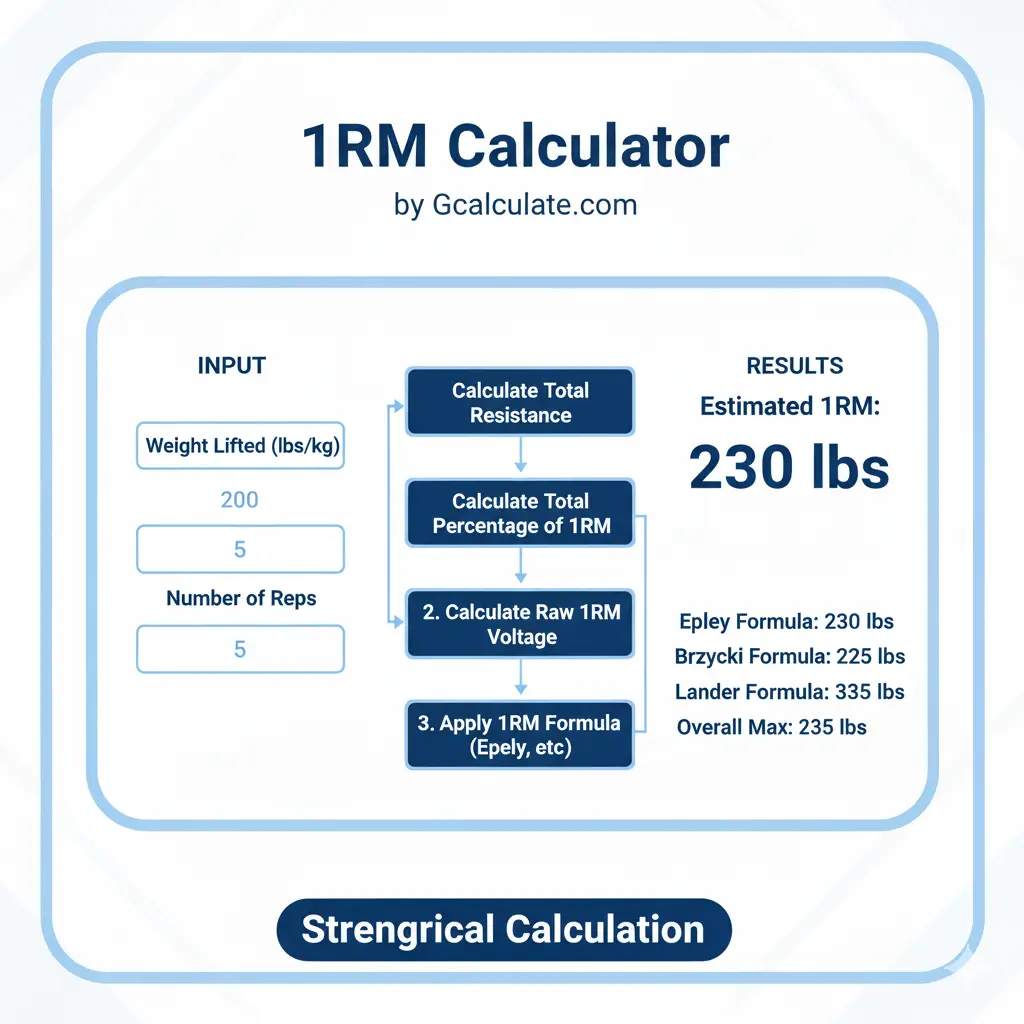
One Rep Max (1RM) Calculator
Estimate your maximum lift using 6 scientifically validated formulas. Get training percentages, strength curves, and personalized load charts instantly.
Training Percentages
| Intensity | Weight |
|---|
Rep Range Equivalents
| Reps | Est. Weight | % of 1RM |
|---|
Frequently Asked Questions
How to Use This 1RM Calculator Effectively
For the most accurate estimation, use a weight you can lift for 2 to 6 repetitions with good form, stopping 1–2 reps shy of failure. The calculator works with any compound barbell exercise — bench press, back squat, deadlift, overhead press, or barbell row. Simply enter the weight and reps, select your unit, and hit calculate. The tool instantly generates your estimated 1RM across six validated formulas, along with training percentages and a rep-range equivalent chart.
Understanding the Six Formulas Behind Your Estimate
This calculator doesn’t rely on a single equation. It runs your numbers through six independently developed formulas and presents each result alongside the average:
- Epley Formula: Weight × (1 + Reps / 30) — Developed from military fitness data, slightly more generous at higher rep counts.
- Brzycki Formula: Weight × 36 / (37 − Reps) — The most commonly cited formula, validated across multiple athletic populations.
- Lander Formula: Weight × 100 / (101.3 − 2.67123 × Reps) — A conservative estimate favored in powerlifting coaching.
- Lombardi Formula: Weight × Reps^0.10 — Based on exponential fatigue modeling, unique mathematical approach.
- O’Conner Formula: Weight × (1 + 0.025 × Reps) — The most conservative linear model, best for higher-rep inputs.
- McGlothin Formula: Weight × (100 / (101.3 − 2.67123 × Reps)) — Similar foundation to Lander with slight computational variations.
When to Update Your 1RM Estimate
Your 1RM is not static — it changes as you get stronger. For ongoing program design, re-estimate every 3–4 weeks using a fresh sub-maximal set. If you’re in a deload week, use the heaviest set from your previous training week. Avoid estimating from sets taken to absolute muscular failure, as form breakdown skews the data. Track your estimates over time to identify trends in your strength development across different lifts.
1RM Estimation vs. Actual Testing: A Practical Guide
Research published in the Journal of Strength and Conditioning Research shows that sub-maximal 1RM prediction equations are accurate to within 2.5–5.5% for reps under 6. For non-competitive lifters, this margin of error is far outweighed by the reduced injury risk and lower fatigue cost. Save actual 1RM testing for competition prep peaking blocks, and use this calculator for day-to-day programming. Your progress will be indistinguishable — but your joints will thank you.