Milliliters to Ounces Conversion
Converting between milliliters (ml) and ounces (specifically fluid ounces, fl oz) is a critical task for cooking, baking, bartending, medicine, and other fields requiring precise liquid measurements. Milliliters are a metric unit of volume used globally, while fluid ounces are an imperial unit primarily used in the United States. This guide provides a detailed explanation of the conversion process, including formulas, step-by-step instructions, and a conversion chart for milliliters to US fluid ounces, liters, cups, tablespoons, teaspoons, grams, and gallons. It also covers specific conversions for commonly queried values like 750 ml to oz or 1 cup to ml, ingredient-specific conversions (e.g., water, flour), and regional variations (e.g., UK, Canada). Frequently asked questions, such as “Is 250 mL the same as 8 oz?” or “How many mL are in 1 oz?” are addressed to ensure clarity for all applications. The focus is on US fluid ounces unless otherwise specified, as they are the most common in recipes and everyday use. Also check this Ounces to Milliliters Converter.
What Is a Milliliter?
A milliliter (ml, sometimes misspelled as “mls” or “ml cc”) is a metric unit of volume equal to one-thousandth of a liter or one cubic centimeter (cm³). It’s widely used worldwide for precise measurements in cooking, medicine, science, and industry, often marked on measuring cups, syringes, or bottles. The metric system’s base-10 structure simplifies scaling: 10 ml = 1 centiliter, 100 ml = 1 deciliter, 1,000 ml = 1 liter. Note: 1 ml = 1 cc (cubic centimeter), so “ml cc to ml” conversions are 1:1.
What Is a Fluid Ounce?
A fluid ounce (fl oz) is a unit of volume in the US customary and imperial systems, used for liquid measurements. In the US, 1 fluid ounce equals exactly 29.5735295625 milliliters. The UK imperial fluid ounce, less common, equals approximately 28.4130625 milliliters. This guide focuses on the US fluid ounce unless noted, as it’s standard in most recipes and applications. Fluid ounces differ from weight ounces (used for mass), so context is critical. Also check out Tablespoons to Cups Converter.
How to Convert Milliliters to Fluid Ounces
Converting milliliters to fluid ounces (or vice versa) is straightforward with the correct conversion factor:
-
Identify the ounce type: Use 29.5735295625 ml per US fluid ounce (or 28.4130625 ml for UK imperial).
-
Apply the formula:
- Milliliters to US fluid ounces: Fluid Ounces = Milliliters ÷ 29.5735295625
- US fluid ounces to milliliters: Milliliters = Fluid Ounces × 29.5735295625
Conversion Formulas
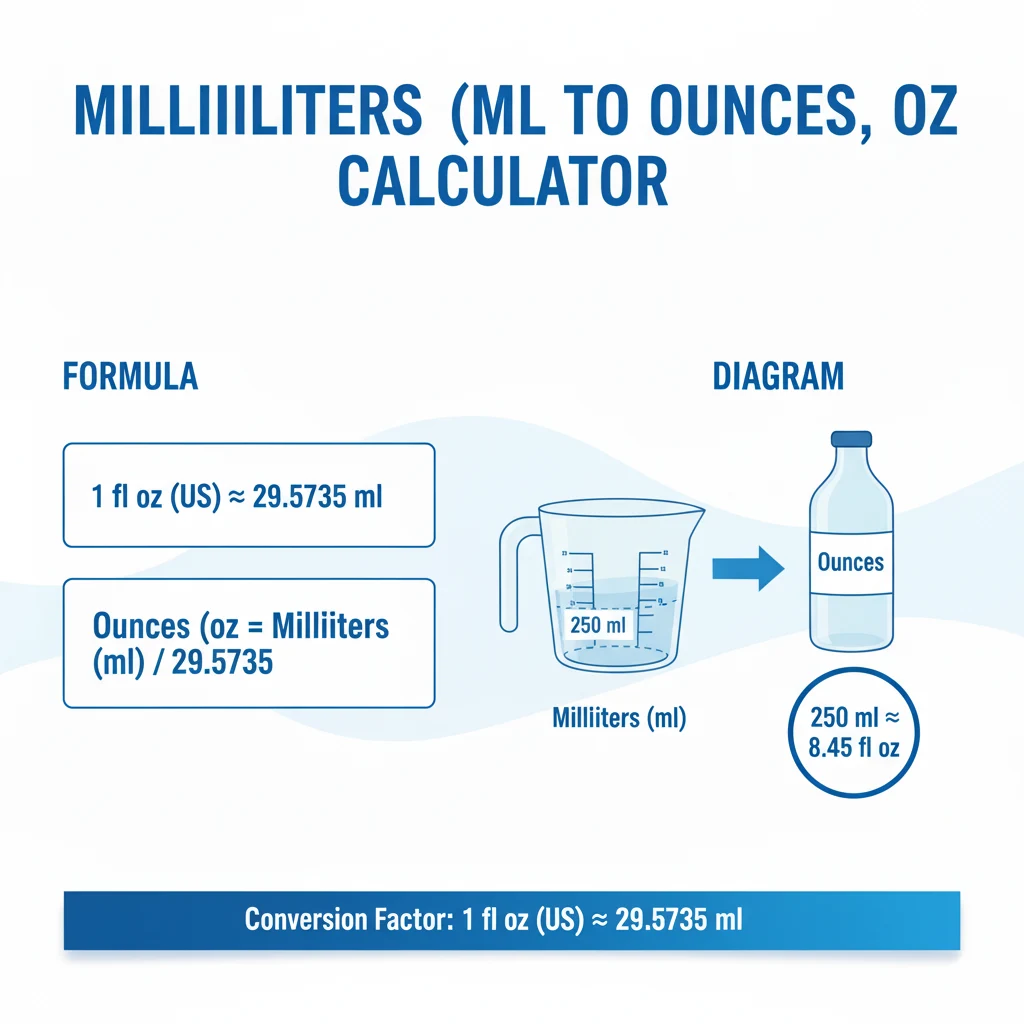
Below are the key formulas for converting milliliters to various units, addressing terms like “ml to ounces,” “ml to liters,” “ml to cups,” and more:
-
Milliliters to US Fluid Ounces: Fluid Ounces = Milliliters ÷ 29.5735295625
-
US Fluid Ounces to Milliliters: Milliliters = Fluid Ounces × 29.5735295625
-
Milliliters to Liters: Liters = Milliliters ÷ 1000
-
Liters to Milliliters: Milliliters = Liters × 1000
-
Milliliters to US Cups: Cups = Milliliters ÷ 236.588
-
Milliliters to US Tablespoons: Tablespoons = Milliliters ÷ 14.78676478125
-
Milliliters to US Teaspoons: Teaspoons = Milliliters ÷ 4.92892159375
-
Milliliters to US Gallons: Gallons = Milliliters ÷ 3785.411784
-
Milliliters to Grams (Water): Grams = Milliliters × Density (for water, density = 1 g/ml)
-
Milliliters to Milligrams: Milligrams = Milliliters × Density × 1000
Example: 500 ml to liters = 500 ÷ 1000 = 0.5 liters.
Milliliters to Fluid Ounces Conversion Chart
This chart provides conversions for common milliliter values to US fluid ounces, rounded to 3 decimal places, addressing terms like “ml to ounces chart” or “mls to ounces conversion chart”:
|
Milliliters (ml)
|
US Fluid Ounces (fl oz)
|
|
5 ml
|
0.169 |
|
10 ml
|
0.338 |
|
30 ml
|
1.014 |
|
50 ml
|
1.690 |
|
100 ml
|
3.381 |
|
120 ml
|
4.057 |
|
150 ml
|
5.072 |
|
187 ml
|
6.323 |
|
200 ml
|
6.763 |
|
250 ml
|
8.453 |
|
300 ml
|
10.144 |
|
375 ml
|
12.680 |
|
400 ml
|
13.526 |
|
500 ml
|
16.907 |
|
600 ml
|
20.288 |
|
750 ml
|
25.361 |
|
1000 ml
|
33.814 |
Fluid Ounces to Milliliters Conversion Chart
This chart converts common US fluid ounce values to milliliters, rounded to 3 decimal places, addressing terms like “ounces to ml chart” or “oz ounce to ml”:
|
US Fluid Ounces (fl oz)
|
Milliliters (ml)
|
|
1 fl oz
|
29.574 |
|
2 fl oz
|
59.147 |
|
2.5 fl oz
|
74.434 |
|
3 fl oz
|
88.721 |
|
3.2 fl oz
|
94.635 |
|
3.4 fl oz
|
100.549 |
|
4 fl oz
|
118.294 |
|
5 fl oz
|
147.867 |
|
6 fl oz
|
177.441 |
|
8 fl oz
|
236.588 |
|
12 fl oz
|
354.882 |
|
16 fl oz
|
473.176 |
|
20 fl oz
|
591.471 |
|
24 fl oz
|
709.765 |
|
30 fl oz
|
887.206 |
|
32 fl oz
|
946.353 |
|
40 fl oz
|
1182.941 |
Milliliters to Other Units Conversion Chart
This chart covers conversions from milliliters to liters, cups, tablespoons, teaspoons, gallons, and grams (for water), addressing terms like “ml to l,” “ml to cups,” “ml to tbsp,” and “ml to tsp”:
|
Milliliters (ml)
|
Liters
|
US Cups
|
US Tablespoons
|
US Teaspoons
|
US Gallons
|
Grams (Water)
|
|
5 ml
|
0.005 |
0.021 |
0.338 |
1.014 |
0.001 |
5 |
|
10 ml
|
0.01 |
0.042 |
0.676 |
2.029 |
0.003 |
10 |
|
30 ml
|
0.03 |
0.127 |
2.029 |
6.087 |
0.008 |
30 |
|
50 ml
|
0.05 |
0.211 |
3.381 |
10.144 |
0.013 |
50 |
|
100 ml
|
0.1 |
0.423 |
6.763 |
20.288 |
0.026 |
100 |
|
150 ml
|
0.15 |
0.634 |
10.144 |
30.433 |
0.040 |
150 |
|
187 ml
|
0.187 |
0.791 |
12.649 |
37.946 |
0.049 |
187 |
|
200 ml
|
0.2 |
0.845 |
13.526 |
40.577 |
0.053 |
200 |
|
250 ml
|
0.25 |
1.057 |
16.907 |
50.721 |
0.066 |
250 |
|
300 ml
|
0.3 |
1.268 |
20.288 |
60.865 |
0.079 |
300 |
|
375 ml
|
0.375 |
1.585 |
25.361 |
76.082 |
0.099 |
375 |
|
400 ml
|
0.4 |
1.691 |
27.052 |
81.154 |
0.106 |
400 |
|
500 ml
|
0.5 |
2.113 |
33.814 |
101.442 |
0.132 |
500 |
|
600 ml
|
0.6 |
2.536 |
40.577 |
121.730 |
0.158 |
600 |
|
750 ml
|
0.75 |
3.170 |
50.721 |
152.163 |
0.198 |
750 |
|
1000 ml
|
1.0 |
4.227 |
67.628 |
202.884 |
0.264 |
1000 |
Conversions for Specific Ingredients
Milliliters to Ounces Water
Water (density = 1 g/ml) converts directly by volume. Example: 100 ml water = 100 ÷ 29.5735295625 ≈ 3.381 US fl oz. The same applies to other liquids (e.g., milk, oil) for volume-based conversions. Also check Cups to Milliliters Converter.
Milliliters to Grams (Water, Other Liquids)
For water: 1 ml = 1 gram. Examples:
-
100 ml water = 100 grams
-
250 ml water = 250 grams For other liquids, multiply by density (e.g., oil ≈ 0.92 g/ml, so 100 ml oil ≈ 92 grams).
Milliliters to Grams Flour
Flour (density ≈ 0.53 g/ml) requires density for gram conversions. Example: 100 ml flour ≈ 53 grams. Volume conversions (e.g., ml to cups) are direct: 100 ml = 0.423 US cups.
Regional Conversions
Milliliters to Ounces UK
For UK imperial fluid ounces: Fluid Ounces = Milliliters ÷ 28.4130625. Example: 100 ml ≈ 3.519 UK fl oz. Modern UK recipes often use metric cups (250 ml) or milliliters directly.
Milliliters to Ounces Canada
Canada uses US fluid ounces for some recipes but primarily metric measurements. Example: 100 ml = 3.381 US fl oz. Confirm recipe context for accuracy.
Specific Milliliters to Fluid Ounces Conversions
Below are conversions for frequently queried values, using US fluid ounces, rounded to 3 decimal places unless noted:
750 ml to oz – 750 ml is approximately 25.36 ounces.
50 ml to oz – 50 ml is approximately 1.69 ounces.
200 ml to oz – 200 ml is approximately 6.76 ounces.
3.4 oz to ml – 3.4 oz is approximately 100.55 milliliters.
375 ml to oz – 375 ml is approximately 12.68 ounces.
150 ml to oz – 150 ml is approximately 5.07 ounces.
1.7 oz to ml – 1.7 oz is approximately 50.27 milliliters.
300 ml to oz – 300 ml is approximately 10.14 ounces.
120 ml to oz – 120 ml is approximately 4.06 ounces.
5 ml to Ounces
5 ml ÷ 29.5735295625 ≈ 0.169 fl oz.
10 ml to Ounces
10 ml ÷ 29.5735295625 ≈ 0.338 fl oz.
30 ml to Ounces
30 ml ÷ 29.5735295625 ≈ 1.014 fl oz.
40 ml to Ounces
40 ml ÷ 29.5735295625 ≈ 1.352 fl oz.
50 ml to Ounces
50 ml ÷ 29.5735295625 ≈ 1.690 fl oz.
100 ml to Ounces
100 ml ÷ 29.5735295625 ≈ 3.381 fl oz.
120 ml to Ounces
120 ml ÷ 29.5735295625 ≈ 4.057 fl oz.
150 ml to Ounces
150 ml ÷ 29.5735295625 ≈ 5.072 fl oz.
187 ml to Ounces
187 ml ÷ 29.5735295625 ≈ 6.323 fl oz (common for wine bottles).
200 ml to Ounces
200 ml ÷ 29.5735295625 ≈ 6.763 fl oz.
250 ml to Ounces
250 ml ÷ 29.5735295625 ≈ 8.453 fl oz.
300 ml to Ounces
300 ml ÷ 29.5735295625 ≈ 10.144 fl oz.
375 ml to Ounces
375 ml ÷ 29.5735295625 ≈ 12.680 fl oz.
400 ml to Ounces
400 ml ÷ 29.5735295625 ≈ 13.526 fl oz.
500 ml to Ounces
500 ml ÷ 29.5735295625 ≈ 16.907 fl oz.
600 ml to Ounces
600 ml ÷ 29.5735295625 ≈ 20.288 fl oz.
750 ml to Ounces
750 ml ÷ 29.5735295625 ≈ 25.361 fl oz (standard wine bottle).
1000 ml to Ounces
1000 ml ÷ 29.5735295625 ≈ 33.814 fl oz.
Specific Fluid Ounces to Milliliters Conversions
1 Ounce to Milliliters
1 US fl oz = 29.5735295625 ≈ 29.574 ml. Also referred to as “1oz to ml.”
2 Ounces to Milliliters
2 US fl oz = 59.147 ml.
2.5 Ounces to Milliliters
2.5 US fl oz = 74.434 ml.
3 Ounces to Milliliters
3 US fl oz = 88.721 ml.
3.2 Ounces to Milliliters
3.2 US fl oz = 94.635 ml.
3.4 Ounces to Milliliters
3.4 US fl oz = 100.549 ml (common for travel-sized toiletries).
4 Ounces to Milliliters
4 US fl oz = 118.294 ml.
5 Ounces to Milliliters
5 US fl oz = 147.867 ml.
6 Ounces to Milliliters
6 US fl oz = 177.441 ml.
8 Ounces to Milliliters
8 US fl oz = 236.588 ml (equals 1 US cup). Also referred to as “8oz to ml.”
12 Ounces to Milliliters
12 US fl oz = 354.882 ml (standard soda can). Also referred to as “12oz to ml.”
16 Ounces to Milliliters
16 US fl oz = 473.176 ml (standard pint). Also referred to as “16oz to ml.”
20 Ounces to Milliliters
20 US fl oz = 591.471 ml.
24 Ounces to Milliliters
24 US fl oz = 709.765 ml. Also referred to as “24oz to ml.”
30 Ounces to Milliliters
30 US fl oz = 887.206 ml.
32 Ounces to Milliliters
32 US fl oz = 946.353 ml.
40 Ounces to Milliliters
40 US fl oz = 1182.941 ml.
Specific Conversions to Other Units
Milliliters to Cups
Milliliters to Liters
Milliliters to Tablespoons
Milliliters to Teaspoons
Milliliters to Gallons
Milliliters to Milligrams
Requires density (mg = ml × density × 1000). For water: 1 ml = 1000 mg. Example: 100 ml water = 100,000 mg.
FAQs
Is 1 ounce the same as 30 mL?
No, 1 US fl oz = 29.5735295625 ≈ 29.574 ml. 30 ml ≈ 1.014 US fl oz, slightly more than 1 oz.
Is 100 mL 2 ounces?
No, 100 ml ≈ 3.381 US fl oz, not 2 oz. 2 US fl oz = 59.147 ml.
Is 250 mL the same as 8 oz?
No, 250 ml ≈ 8.453 US fl oz, slightly more than 8 oz. 8 US fl oz = 236.588 ml.
How many mL are in 1 oz?
1 US fl oz = 29.5735295625 ≈ 29.574 ml.
Converting milliliters to fluid ounces, or vice versa, is straightforward with the formula Fluid Ounces = Milliliters ÷ 29.5735295625 for US measurements. This guide provides precise conversions for values like 100 ml (3.381 fl oz), 750 ml (25.361 fl oz), or 8 oz (236.588 ml), as well as conversions to liters, cups, tablespoons, teaspoons, gallons, and grams. Whether measuring water, flour, or other liquids, use standard measuring tools or digital calculators for accuracy in cooking, baking, or other applications.