Mortgage Overpayment Calculator
A Mortgage Overpayment Calculator is a powerful financial tool that helps homeowners understand how extra payments on their mortgage can save them thousands in interest and reduce the loan term. By making additional payments — either monthly or as a lump sum — you can see how quickly you’ll pay off your mortgage and how much interest you’ll avoid.
Whether you’re considering making small monthly overpayments or a one-time payment, this calculator gives you instant insights into how your financial decisions impact your mortgage timeline. You can check our Mortgage Calculator.
What Is a Mortgage Overpayment Calculator?
A Mortgage Overpayment Calculator is an online tool that shows how overpaying your mortgage affects your repayment period and total interest. It takes into account your loan amount, interest rate, remaining term, and overpayment amount to display how much faster you could become mortgage-free.
For example, adding just an extra $100 per month to your mortgage payment can shorten your loan by several years and save you thousands in interest. The calculator provides a detailed comparison between your original payment schedule and the adjusted one after overpayments.
How Does the Mortgage Overpayment Calculator Work?
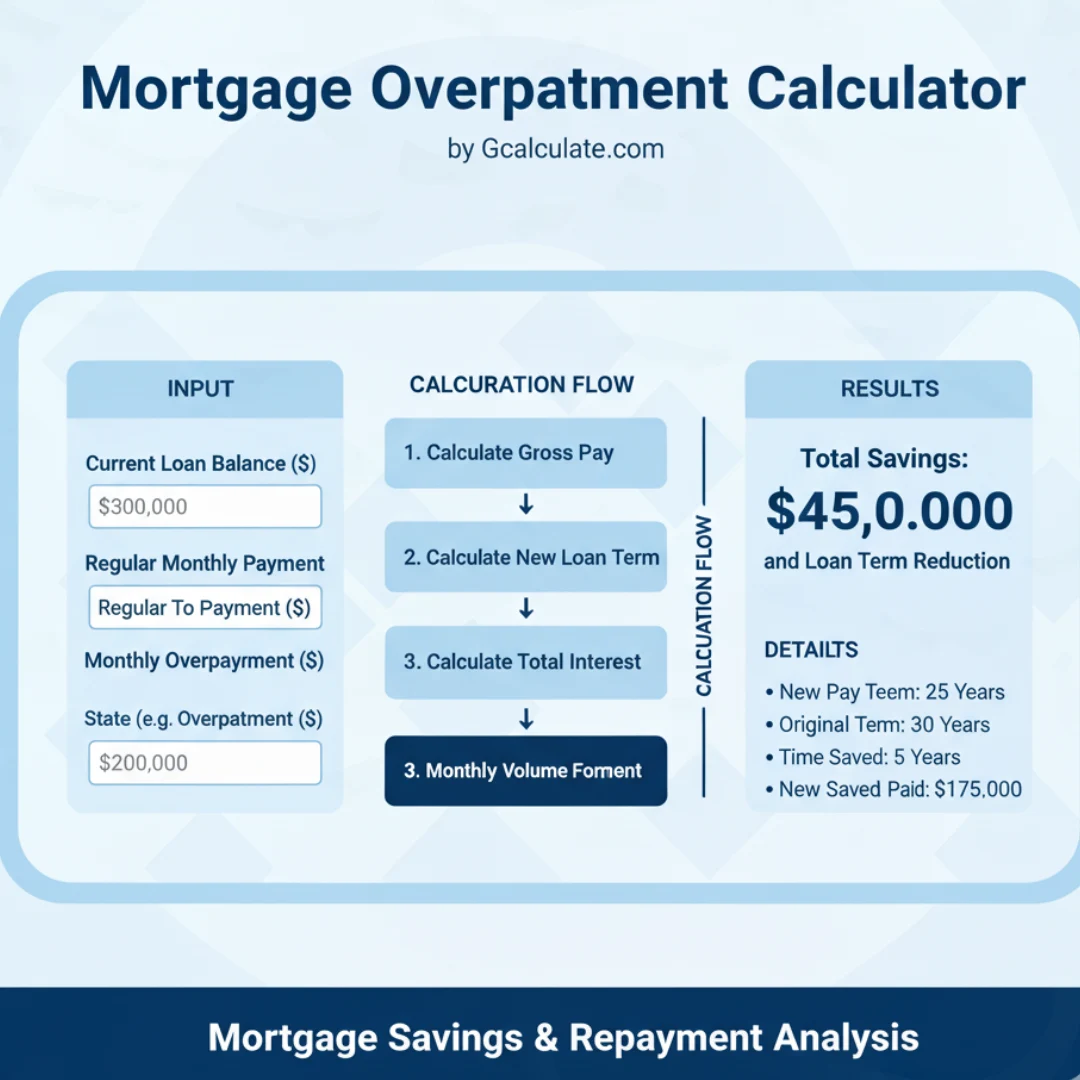
The calculator works by recalculating your amortization schedule — that’s the breakdown of how each monthly payment goes toward interest and principal. Here’s how it works step by step:
-
Enter Mortgage Details:
Input your total loan amount, remaining balance, interest rate, and term (in years).
-
Add Overpayment Information:
Enter how much extra you plan to pay — either monthly or as a one-time lump sum.
-
Calculation:
The tool automatically recalculates your mortgage schedule and shows:
- New total interest paid
- Revised loan end date
- Total savings in interest
- Years or months saved off your loan term
-
Comparison Output:
You’ll see a side-by-side comparison of your current mortgage vs. your overpayment scenario.
This gives a clear visual of how much money and time you can save by slightly adjusting your payments.
Mortgage Overpayment Calculator Formula
Step 1: Standard Monthly Payment (Without Overpayment)
M=P×r(1+r)n(1+r)n−1M = P \times \frac{r(1 + r)^n}{(1 + r)^n – 1} M=P×(1+r)n−1r(1+r)n
Where:
- M = Monthly payment
- P = Loan principal (amount borrowed)
- r = Monthly interest rate = annual_rate / 12
- n = Original loan term in months = years × 12
Step 2: Remaining Balance After t Payments
Bt=P×(1+r)t−M×(1+r)t−1rB_t = P \times (1 + r)^t – M \times \frac{(1 + r)^t – 1}{r} Bt=P×(1+r)t−M×r(1+r)t−1
Where:
- B_t = Balance after t months
- Use this to verify payoff or simulate amortization
Types of Mortgage Overpayments
There are two main ways to overpay your mortgage:
1. Regular Monthly Overpayments
You pay a little extra each month on top of your standard mortgage payment.
Example: If your monthly mortgage payment is $1,200 and you add an extra $100, the calculator will show how this small adjustment can significantly cut your loan term.
2. Lump Sum Overpayments
You make a one-time large payment — perhaps from a work bonus, tax refund, or savings.
Example: Paying a $5,000 lump sum early in your mortgage can reduce the total interest by several thousand dollars over the loan term.
The calculator allows you to test both methods to see which offers the most savings based on your situation.
2025 UK Mortgage Rates and Overpayment Rules
Average rates (2025):
- 2-year fixed: 4.6%
- 5-year fixed: 4.3%
- Variable (SVR): 7.5%
Overpayment allowance: Most lenders allow 10% of balance annually without ERC.
- ERC: 1–5% in fixed period
- LTV impact: <60% LTV → lower rates
Help to Buy/Equity Loan: Overpay interest-free portion only.
Example: £300,000, 4.2%, 30 years, £500/month over
- Original interest: £198,000
- New term: 19 years
- Saved: £82,000
- ERC check: £3,000 (if within fixed term)
A Mortgage Overpayment Calculator empowers you to take charge of your financial future. By exploring different overpayment scenarios, you can clearly see how even modest extra payments can help you save thousands of dollars and become debt-free years earlier.
Instead of being locked into your original term, you can experiment with monthly or lump-sum overpayments and instantly see how they affect your payoff timeline. If you want to achieve financial freedom faster, reduce interest costs, and own your home outright sooner — this tool is your first step toward smarter mortgage management.
Frequently Asked Questions (FAQs)
What is a Mortgage Overpayment Calculator?
A Mortgage Overpayment Calculator helps you estimate how additional payments — whether monthly or one-time lump sums — affect your mortgage. It shows how much interest you can save and how many years you can cut from your loan term by overpaying.
How does the Mortgage Overpayment Calculator work?
Simply enter your loan amount, interest rate, remaining term, and overpayment amount. The calculator then compares your current mortgage schedule with your new overpayment plan, showing total interest saved and how early you can pay off your mortgage.
Can I overpay my mortgage every month?
Yes. Many homeowners choose to make regular monthly overpayments by adding a fixed extra amount to each payment. Even a small monthly increase — like $50 or $100 — can significantly shorten your mortgage term and reduce total interest.
What’s the difference between lump-sum and monthly overpayments?
-
Lump-sum overpayments: One-time large payments (e.g., from bonuses or savings) that immediately reduce your principal.
-
Monthly overpayments: Smaller, consistent extra payments added to your regular installments.
Both methods save money on interest, but lump sums give a more immediate reduction in the loan balance.
Are there any limits or penalties for overpaying?
Some lenders allow up to 10% of your outstanding balance to be overpaid each year without penalty. Always check your mortgage terms, as exceeding that limit may trigger early repayment fees.
How much interest can I save by overpaying my mortgage?
The savings depend on your loan size, interest rate, and overpayment amount. For example, overpaying just $100 per month on a 25-year mortgage could save you tens of thousands in interest and reduce your loan term by several years.
Should I overpay my mortgage or save the money?
If your mortgage interest rate is higher than what you’d earn from savings, overpaying makes more sense financially. However, ensure you keep an emergency fund before committing to larger overpayments.
Does overpaying affect my monthly payments?
It depends on your lender. Some lenders reduce your loan term (keep payments the same but finish earlier), while others reduce your monthly payment but keep the original term length. Choose whichever option fits your financial goals.